Analytical Chemistry — Standard Solutions & Titration
Cameroon GCE Ordinary Level Notes (Based on National Curriculum)
Standard Solution
Definition
A standard solution is one whose concentration is accurately known. It is usually prepared from a pure substance known as a primary standard.
Preparation Steps (just 03 steps)
- Weigh the solid accurately using a balance.
- Dissolve the solid in a beaker using distilled water.
- Transfer the solution into a volumetric flask and rinse and Make up to the mark with distilled water.
Use a primary standard that is pure, stable, and non-hygroscopic (e.g., anhydrous Na₂CO₃).
Titration
Definition
Titration is a method used to determine the concentration of an unknown solution by reacting it with a standard solution until the end-point is reached.
Procedure
- Rinse and set up burette, pipette, and conical flask properly.
- Pipette a measured volume of the unknown solution into the flask and add a few drops of an indicator.
- Fill the burette with the standard solution and record the initial reading.
- Add titrant gradually while swirling the flask until the indicator changes colour.
- Record the final reading and calculate the titre value.
- Repeat until you obtain at least three concordant readings.
Safety: Always wear goggles.
Equipment Used in Titration
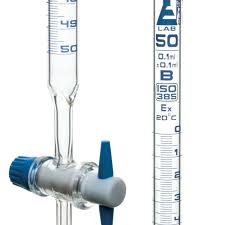 Burette
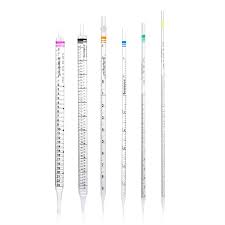 Pipette
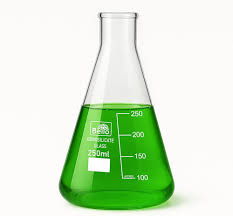 Conical Flask
 Stand & Clamp
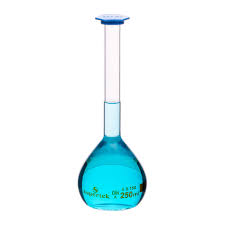 Volumetric Flask
Common Indicators
| Indicator | Colour Change | Used In |
|---|---|---|
| Phenolphthalein | Colourless → Pink | Strong acid vs strong base |
| Methyl Orange | Red → Yellow | Strong acid vs weak base |
| Bromothymol Blue | Yellow → Blue | Neutral titrations |
| KMnO₄ (self-indicator) | Colourless → Faint pink | Redox titrations |
Summary of Key Points
- A standard solution has a known concentration.
- Primary standards must be pure, stable, and non-hygroscopic.
- Titration is used to find unknown concentrations using accurate volumetric apparatus.
- Indicators show the end point through colour change.
- Always rinse equipment properly and take readings at eye level.
Student Review Questions & Answers
1. Define a standard solution.
A solution whose concentration is accurately known.
A solution whose concentration is accurately known.
2. Mention any two properties of a primary standard.
It must be pure and non-hygroscopic.
It must be pure and non-hygroscopic.
3. Name three apparatus used in titration.
Burette, pipette, conical flask.
Burette, pipette, conical flask.
4. Why is a white tile used during titration?
To clearly observe the colour change at the end point.
To clearly observe the colour change at the end point.
5. Give one example of an indicator used in acid-base titration.
Phenolphthalein.
Phenolphthalein.