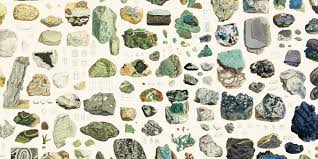
Mineralogy Topics
1. Meaning of Mineralogy
Mineralogy is the branch of geology that studies minerals — their physical properties, chemical composition, formation and economic value.
2. What Are Minerals?
A mineral is a naturally occurring, inorganic solid with a definite chemical composition and ordered atomic structure.
3. Physical Properties of Minerals
- Colour: Visible mineral colour.
- Streak: Powder colour on porcelain.
- Hardness: Measured with Mohs scale (1–10).
- Lustre: Metallic, glassy, dull, waxy.
- Cleavage: Breaks along flat planes.
- Fracture: Irregular breaks.
- Density: Mass per volume.
- Crystal Shape: Cubic, tetragonal, hexagonal.
4. Classification of Minerals
- Silicates: Quartz, mica, feldspar.
- Carbonates: Calcite, dolomite.
- Sulphides: Pyrite, galena.
- Oxides: Hematite, magnetite.
- Halides: Halite, fluorite.
5. Economic Importance of Minerals in Cameroon
- Bauxite: Aluminum production.
- Gold: Export and jewelry.
- Diamond: Industrial and export.
- Iron ore: Steel industry.
- Limestone: Cement manufacturing.
- Clay: Bricks and ceramics.
Major Mining Areas
- Batouri – Gold
- Mbalam – Iron ore
- Lolodorf – Nickel/Cobalt
- Garoua – Limestone
- Kadey Division – Diamonds
6. Formation of Minerals
- Cooling of magma.
- Evaporation of mineral-rich water.
- Metamorphic processes.
- Precipitation from solutions.
7. Mineral Identification Methods
- Hardness test
- Streak test
- Acid test
- Magnetism
- Crystal form observation