Definition of Electricity
Electricity is the flow of electric charge, typically through a conductor like a wire. It is used to power devices and transfer energy.
Key Terms
- Current (I): Flow of electric charge. Measured in amperes (A).
- Voltage (V): Electric potential difference. Measured in volts (V).
- Resistance (R): Opposition to current flow. Measured in ohms (Ω).
- Power (P): Rate of energy use. Measured in watts (W).
- Charge (Q): Quantity of electricity. Measured in coulombs (C).
Ohm’s Law
Formula: V = I × R
Example 1:
A resistor has R = 5 Ω and I = 2 A. Find V.
Solution: V = 2 × 5 = 10 V
Example 2:
A bulb uses 12 V and has R = 6 Ω. Find I.
Solution: I = 12 / 6 = 2 A
Resistance
Resistance is the property of a material that opposes the flow of electric current.
Formula: R = V / I or R1/R2 ×R1/R2
Example:
V = 10 V, I = 2 A → R = 10 / 2 = 5 Ω
Materials and Ohm’s Law
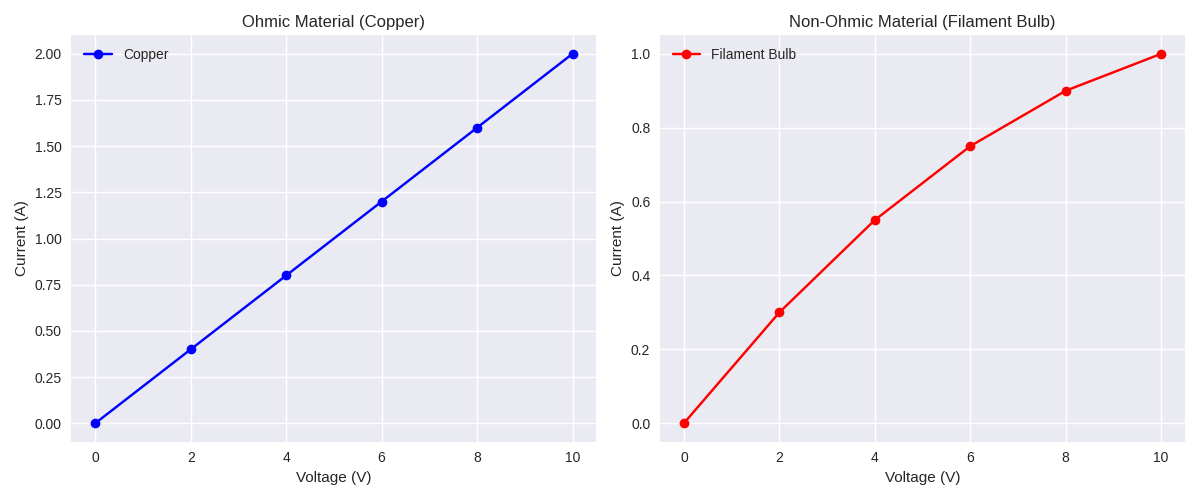
- Ohmic Materials: Obey Ohm’s Law. Current increases linearly with voltage.
Examples: Copper, Nichrome
- Non-Ohmic Materials: Do not obey Ohm’s Law. Current does not increase linearly.
Examples: Filament bulb, diode
Graph 1: Ohmic Material (Copper)
A straight line showing constant resistance.
Current increases proportionally with voltage.
Graph 2: Non-Ohmic Material (Filament Bulb)
A curved line showing increasing resistance.
Current increases slowly as voltage rises.